- Business Tips
Lessons Learned For Startup User Signups
By Brett Cooper
Startup Sales 101 - Conversions
For any web service based startup, sales are driven by 2 key factors:
- People visiting your site - You’ve got to get people to your site. Whether it’s viral campaigns, one-on-one sales, online ads, or traditional marketing, people need to see your product or service. For online advertising this is typically the ‘Click Through Rate’.
- People signing up for your service - Once people take a look at your site, you need to make a compelling case for them to sign up. This is your ‘Conversion Ratio’.
While there’s always room to improve the number of eyes reaching your pages (e.g. throw more money into advertising), you should be most interested in improving your conversion ratio.
Lessons Learned – “Why isn’t everyone signing up?”
In addition to the new features we rolled out recently (more here), we invested a considerable amount of time into updating our pricing and signup model. The LessMeeting homepage, features, registration, and pricing pages all got makeovers. Why? Simple – we needed to make the decision to try LessMeeting simpler.
Using tools like Google analytics we analyzed why people were coming to the site but not signing up. (Of course they could simply be disinterested in the product, but our research has told us that typically isn’t the problem.) The 2 culprits we discovered were:
- Features and benefits need to be very clear – We overwhelmed users with too much information. We had to make key benefits as clear as possible so visitors could understand why this tool would help them.
- The signup process & pricing model must be dead simple – We had too many pricing tiers and our trial/freemium model was too complex.
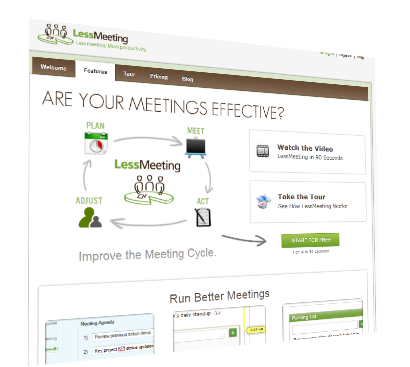 |
| The new Features page |
The Make-Over
We learned that customers were getting too confused about our pricing & registration and as a result, bailing on us before even giving LessMeeting a try. In retrospect I don’t blame them…and I’m especially impressed by those who made it through! So let’s look at a few mistakes that we made and how we approached a new solution.
Mistake #1 – A Complex Freemium Model
The Intent – Meetings are a team activity and we wanted to encourage teams to try LessMeeting together. In our initial freemium model, the first 3 customers at a company (defined by email address domain) could sign up for free and any additional users from that domain would have to pay for an account.
What really happened – Too complex! How do you define a “company”? What if all 3 licenses have been taken up but there is someone else at the company who really wants to try your product? What if the 3 licenses are taken up by a team in a completely different area of the company than someone new who wants to try the product? These questions go on…and get worse.
How we’re making it better – Don’t over-think your freemium model. Remember, the point is to get people using your product in a manner that makes them want to pay for more advanced features. Your freemium approach shouldn’t deter new users from signing up.
We have changed our approach so signing up is free. Always. For everyone. No credit card required. Try LessMeeting for free for 30 days and if you like it after that, then it’s a simple $12 flat fee per user per month.
Summary – Freemiums should be simple. Their goal is to get your product in as many hands as possible; anything else and you’re overdoing it.
Mistake #2 – Too Many Pricing Tiers
The Intent – We originally had three pricing/feature tiers. We thought this would allow us to uniquely cater to power users, casual users, small companies, big companies, team leads, and team members alike.
What really happened – Our customers didn’t need tiers. Every one of our paying customers had signed up for the same middle tier. We got a lot of questions regarding the features related to the different tiers (e.g. “can I pay for the teams pages, but just for 5 of our users?”). In general, we found that having more pricing/feature tiers was just confusing to our users and added barriers to the buying decision.
How we’re making it better – Tiers makes sense for a lot of startups. But not us. If you’re a startup (or any software company) consider if your customers really need the additional pricing levels. We ended up trying to build useless features just to justify different tiers that no one even used. Now we’ve changed to a single tier with a simple $12 flat fee per month.
Summary– If your customers don’t understand your pricing model, don’t try to explain it to them. Change your pricing model.
Mistake #3 - Overzealous Signup Process
The Intent – We wanted to give you all the information we could about LessMeeting so that there was no possible way you wouldn’t want to sign up.
What really happened– No one read the text filled feature pages. Users got lost getting from the homepage to the registration page. There was no call to action. In the end, users didn’t sign up as often as we thought they would.
How we’re making it better – It’s critical that you streamline your signup process. It’s no different than the “shopping cart” process online retailers use. Identify what your target “funnel” is and build your registration process around it, including a clear call to action at each step.
For LessMeeting, we want you to: 1) Start on the homepage, 2) View a much improved features page, 3) View our simplified pricing model, 4) Register and signup, and 5) Start using LessMeeting. Users need to be able to complete this in just a couple minutes too, as that’s likely all you’ll have their attention for.
Summary – Make signup as fast as possible.
Mistake #4 – Complex Incentives
The Intent – We want to encourage customers to buy by providing discounts.
What really happened – Only the squeakiest wheel was heard. All of our customers deserved to know about the discount options but only those that asked about them found out. While we didn’t intentionally hide our discounts, we didn’t do the best job of announcing them either.
How we’re making it better – Advertise your discounts. Sign up for a group of licenses (starting at just 10 users!) and get a discount. Or, pay yearly instead of monthly and get a discount. Discounts should be your friend. We want to give these discounts to every single one of our customers. First, it helps our cash flow (Startup Finance 101) and builds momentum via a larger user base. More importantly, it makes your customers happy.
Summary – Reward your customers for buying behaviors that help out your company too.
Guess the Theme? (hint: it’s a simple answer)
Notice a theme? It’s nothing new, but we needed to be reminded of it so decided it’s worth passing on – Keep It Simple. Having a great product or service is only half the battle for startups…you need to get people to actually sign up for your product. In summary:
- Avoid complex freemium models
- Reduce the complexity of your pricing
- Reduce the number of actions required to signup
- Reward your customers for the right things
- Above all make you product easy to understand